House Leveling in New Braunfels
Comal Foundation Repair provides free house leveling assessments for homeowners across New Braunfels and Comal County. If your floors are uneven or your home appears to be tilting, a free inspection determines how much movement has occurred and what’s needed to correct it.
Request A Free Estimate
Understanding House Leveling and Foundation Repair
House leveling is the process of restoring a home to its original, level position after the foundation has shifted. When one section of a foundation settles more than another, the result is uneven floors, cracking walls, and structural stress that worsens over time. In New Braunfels, house leveling is common because of the region’s expansive clay soils. The clay beneath homes swells during wet periods and shrinks during dry periods, and this cycle rarely affects the entire foundation uniformly. One side of the house may settle while the other stays in place, or the center may drop while the perimeter holds, creating the slopes and tilts that homeowners feel underfoot. House leveling is not a separate service from foundation repair. It is the outcome of foundation repair. The piers, shims, or foam installed during the repair are the tools used to lift and level the structure. Understanding this connection is important because some homeowners search for “house leveling” thinking it’s a different, simpler process. It involves the same structural assessment, pier installation, and hydraulic lifting that any foundation repair project requires.
How House Leveling Works
Step 1: Elevation survey. Before any lifting begins, a digital manometer or laser level maps the elevation at every interior corner and along the exterior walls. This produces a written elevation profile showing exactly where and how much the house has shifted. This baseline measurement is critical because it determines where piers need to be placed and how much lifting each section requires.
Step 2: Pier installation. Based on the elevation survey, piers are installed at the points where the foundation has lost support. For slab homes, this means driving steel or concrete piers through the soil to stable ground. For pier and beam homes, this means replacing or adding piers beneath the beams. The number and placement of piers is determined by the elevation data, not a standard template.
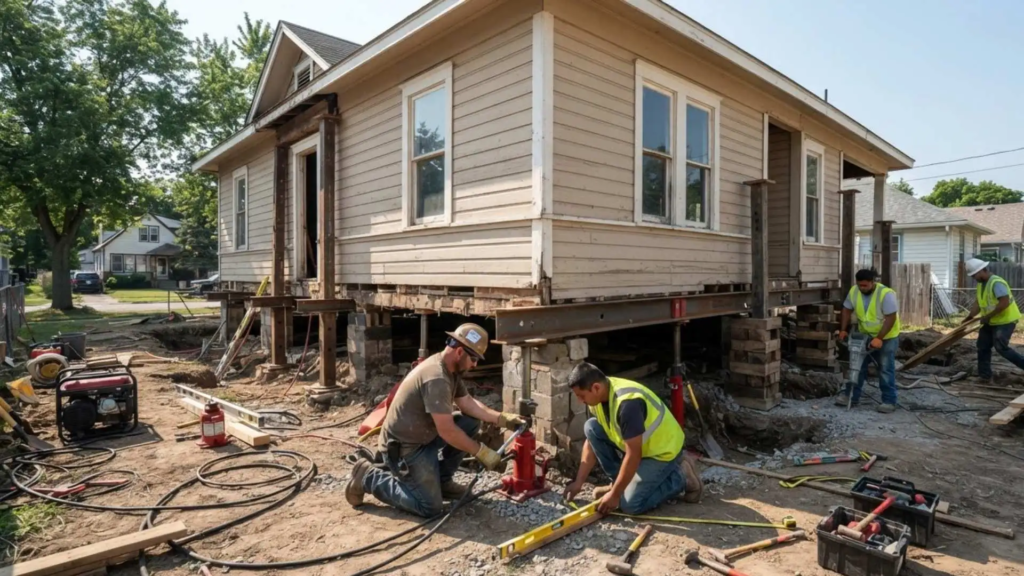
Step 3: Hydraulic lifting. Once piers are in place, hydraulic jacks gradually lift the foundation toward its original elevation. This process is slow and controlled, typically raising the foundation in small increments over several hours. The goal is to recover as much elevation loss as possible without creating new stress on the structure. Plumbing, electrical, and finish materials all respond to the lift, and moving too fast can cause secondary damage.
Step 4: Verification. After lifting, the elevation is surveyed again to confirm the house has been brought back toward level. It’s important to set realistic expectations: in most cases, 50% to 75% of the original settlement can be recovered. Attempting to force the foundation to perfect level can cause additional damage to framing, plumbing, and finishes. The goal is structural safety and functional improvement, not mathematical perfection.
Step 5: Monitoring. After leveling, the foundation is monitored for continued movement. Some settling may occur in the weeks following repair as the structure adjusts to its new position. A reputable contractor will return for follow-up adjustment if needed, and most warranty programs include this monitoring period.
When House Leveling Is Needed
Not every foundation problem requires leveling. Here’s when leveling is the right call:
- Floors slope noticeably, and a ball rolls consistently in one direction
- Interior doors have been trimmed or planed to close despite foundation movement (this means someone already tried to work around the problem instead of fixing it)
- One side of the home visibly sits lower than the other when viewed from outside
- Settlement measurements show more than 1 to 1.5 inches of differential movement across the floor plan
- Structural cracks are actively widening over time, indicating ongoing movement
- Windows or doors that previously worked fine have started sticking or jamming
If your floors feel slightly uneven but you don’t see accompanying cracks or door problems, monitoring may be the appropriate first step rather than immediate repair. A free inspection includes elevation measurements that quantify exactly how much movement has occurred, so you have data rather than guesswork.
What House Leveling Costs
| Scenario | Typical Cost Range |
|---|---|
| Minor leveling (3–5 piers, one area) | $2,000 – $4,000 |
| Standard leveling (6–10 piers, one side) | $4,000 – $8,000 |
| Full-house leveling (10+ piers, multiple areas) | $8,000 – $15,000+ |
Frequently Asked Questions
Can I live in my house during leveling?
Yes. Most house leveling projects don’t require you to leave. The work is done from outside the home (or from the crawl space for pier and beam foundations). You may hear hydraulic equipment and feel minor vibrations, but the process is not disruptive enough to require vacating.
How long does house leveling last?
When piers are driven to stable soil or bedrock, the repair is permanent. The piers themselves don’t move because they bypass the problem soil. However, areas of the foundation that were not piered may still experience movement over time if soil conditions change. Proper drainage maintenance helps prevent future movement in unpiered areas.
Will leveling fix my cracked walls?
Leveling often closes or reduces foundation-related cracks. However, some cracks may remain as cosmetic reminders of the previous movement, especially in drywall and plaster. These can be patched and repainted after the foundation has stabilized. It’s generally recommended to wait 4 to 6 weeks after leveling before making cosmetic repairs, to allow any final settling to occur.
Is house leveling the same as foundation repair?
Yes. House leveling is the result of foundation repair, not a separate service. The foundation is repaired (using piers, shims, or foam), and during that process, the structure is lifted back toward level. Any company offering “leveling” without addressing the underlying foundation problem is providing a temporary fix.
How much of the settlement can be recovered?
In most cases, 50% to 75% of the total settlement can be recovered. Full recovery is not always possible or advisable because forcing the foundation beyond a certain point can cause secondary damage to plumbing, framing, and interior finishes. The goal is to restore the home to a safe, functional condition rather than mathematical perfection.
Get a Free House Leveling Assessment
If your floors are uneven, doors are sticking, or you can see that your home isn’t sitting level, a free inspection gives you the measurements and answers you need. We’ll tell you exactly how much movement has occurred, what’s causing it, and what it takes to correct it. Comal Foundation Repair serves all of New Braunfels and surrounding Comal County communities.